
Marketing to U.S. Buyers: A Playbook for Israeli CEOs and Their Teams
If you’re an Israeli CEO or founder trying to sell to U.S. buyers, you’ve probably noticed that what works easily at home often falls flat in America. You’re bold, fast-moving, and innovative – but your U.S. prospects? They’re cautious, methodical, and a little allergic to risk.
I’ve seen this pattern for years working with Israeli startups. The technology is exceptional. The passion is off the charts. But deals stall, conversations dry up, and the question becomes: Why isn’t this landing?
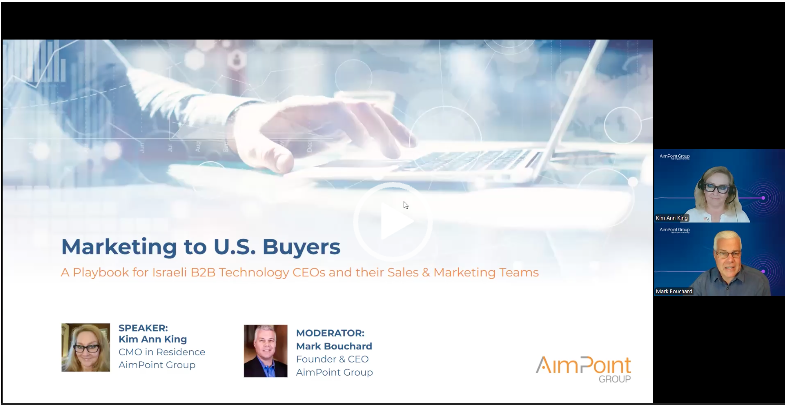
That’s exactly what this blog post is about – how to recognize and bridge the cultural, strategic, and operational gaps between Israeli sellers and American buyers so you can win faster and scale smarter in the U.S. market. This post is a recap of my recent webinar with Mark Bouchard, Founder and CEO of AimPoint Group, which is featured here.
Like the webinar, this post will cover:
- Key cultural and mindset differences between Israeli sellers and U.S. buyers
- How to adapt your messaging and go-to-market approach
- The marketing foundations every Israeli company needs before launching in the U.S.
- Common pitfalls to avoid (and how to overcome them)
So whether you’re planning your first U.S. expansion or refining your GTM strategy, let’s dive into practical, experience-based insights you can put to work immediately.
1) Understanding the Fundamental Gap
Let’s start with the basics: Israelis sell differently than Americans buy.
Israeli founders and executives tend to sell directly, often leading with product features and innovation. Decisions are made fast – it’s a tactical, action-oriented approach. By contrast, American buyers care less about what your product does and more about what it delivers. They ask:
- How will this improve our business outcomes?
- What’s the ROI?
- How much risk am I taking on by saying yes?
And they take their time answering those questions. Buying committees are common. There are multiple stakeholders, formal reviews, and a lot of internal politics. Americans rarely make big bets without a long paper trail.
That’s not wrong; it’s just different. But it means Israeli companies need to slow down, build relationships, and understand that trust and proof are as important as innovation.
Show them your references. Give them customer testimonials. Publish ROI documents and case studies. Thought leadership, too, plays a massive role in credibility, especially for newer brands entering the U.S.
And one very practical tip: be aware of the workweek overlap. Israelis work Sunday–Thursday, Americans Monday–Friday. If you send messages Sunday morning, they may not be seen in the U.S. until Monday. If your buyer replies on Friday afternoon, you may not see it until Sunday. It sounds like a small thing, but these different work schedules can slow communication – and deals.
2) Cultural Considerations: Getting the Best Deal
Every Israeli I’ve worked with knows the word freier, and nobody wants to be one. Israelis are conditioned to negotiate fiercely to get the very best deal possible. They don’t want to be taken advantage of.
Americans? We’re wired differently. We generally trust that others have our best interests at heart. We follow the rules, wait our turn, and don’t usually haggle unless something feels off. What we want is a fair deal, not necessarily the best deal.
This misalignment in deal-making can create tension. When Israeli sellers negotiate too aggressively (or change the scope along the way), Americans can bristle, because they feel like they’re being treated as suckers. That’s a fast way to erode trust.
My advice: yes, negotiate, but know where the line is. U.S. buyers don’t want to feel squeezed or manipulated. Boundaries matter. Agreements matter. And nothing will turn off an American prospect faster than a sense that the goalposts are moving. That destroys our sense of fairness!
3) Mindset Matters More Than You Think
The mindset differences run deep, and they show up in everything from how meetings start to how deals close.
| Israeli Sellers | American Buyers |
| Direct (can seem blunt) | Diplomatic (can seem weak) |
| Debate and negotiate | Seek consensus and harmony |
| Ask about anything (money, politics, religion) | Avoid personal or controversial topics |
| Come as you are | Aspire to project future success |
| Transactional | Relational |
| Guts and chutzpah | Formal and polite |
| Innovation-focused | Vision and outcomes-focused |
| Flexible about time | Deadline-driven |
If you’ve ever joined a U.S. sales call and felt it moved painfully slowly, this is why. Americans value harmony and process. Being “late” or skipping a meeting agenda can read as disrespectful.
Similarly, short-term marketing campaigns (a quick PPC burst, a one-month promo) are common in Israel, but American buyers move on longer cycles. Remember, only about 3% of your potential audience is in-market at any given time. The rest are just gathering information or comparing notes. If you’re not marketing to them long-term, you’re missing them entirely.
Think of marketing as the marathon that gets you into the sales meeting, not the sprint that closes it.
4) Selling Solutions vs. Strategies
Here’s a big one: Israeli companies often see their product as the solution. U.S. buyers see it as one part of a larger strategy.
That means when you sell, you have to position your product in context. Ask yourself:
- How does this fit into the buyer’s overall architecture or business plan?
- Does it integrate with their existing stack?
- Can it replace or consolidate other tools?
In the U.S., consolidation and cost savings are like catnip; if your product reduces complexity or eliminates overlap, say so. But be honest. I’ve seen too many Israeli startups call themselves “platforms” when they’re really point solutions. Americans love all-in-one platforms, but they hate being misled. It’s better to be specific and credible than overpromise and lose trust.
5) Know Your Buyer: Personas and ICPs
If there’s one slide I’d put on every Israeli founder’s wall, it’s this: know exactly who you’re selling to. That means understanding both your buyer personas and your ideal customer profiles (ICPs).
Personas are about people: their titles, pain points, and what success looks like for them. ICPs are about companies: their size, revenue, geography, and industry fit.
Start with three personas, max:
- Buyer: the person who holds the budget.
- Influencer: the technical evaluator or recommender.
- User: the person who’ll live with your product day to day.
Each one needs tailored messaging. The buyer cares about ROI and outcomes. The influencer wants to understand the tech and the innovation. The user wants usability and support.
And don’t forget to meet them where they are. Are they reading trade publications? Following certain analysts? Hanging out on Reddit or Slack groups? If you don’t know where they consume information, you are likely unable to reach them effectively.
6) Positioning and Messaging: Clarity Over Cleverness
If I could change one thing about how Israeli companies market in the U.S., it would be this: stop leading with features, start leading with value.
U.S. buyers want to know what problems you solve and what outcomes they can expect — saved time, reduced risk, increased revenue. They want to see peer validation, customer logos, case studies, analyst coverage, and clear use cases by industry.
What they don’t want:
- Buzzwords and acronyms
- Vague promises
- Exaggerated claims without proof
Here’s a simple framework you can use, which is known as a Value Matrix:
- Pain point – What’s hurting the buyer today?
- Impact – Why does it matter?
- How you help – What does your product do about it?
- Benefit – What result can they expect?
This isn’t marketing fluff; it’s your north star for every piece of content, campaign, and sales conversation.
7) Build a Minimum Marketing Foundation
Before you launch big in the U.S., make sure your marketing basics are solid.
- A U.S.-centric website: written in American English, with no typos, and featuring U.S. contact information.
- Social proof: case studies, design partners, or pilot customers based in the U.S.
- Thought leadership: visible points of view from your founders and executives on your website and social media. Americans love to see confident experts who can articulate a market vision.
And your marketing collateral should align to the U.S. buyer journey:
- Top of Funnel (Awareness): Pain-point content: “Here’s the problem we solve.”
- Middle of Funnel (Consideration & Evaluation): Thought leadership, corporate decks, ROI materials, battlecards, competitive differentiators, social proof, and use cases.
- Bottom of Funnel (Decision): “Getting started” guides, implementation overviews, or internal selling decks to help your champion close the deal internally.
Marketing and sales are partners in the U.S., not a hierarchy. If you treat marketing as secondary to sales, you’ll stall growth. Marketing creates the air cover that allows sales to land.
8) Go-to-Market Strategy: Choose Your Path
Before you start spending, decide on your go-to-market (GTM) model.
- Will you sell directly to customers with your own sales team?
- Will you go channel-first, using resellers or partners?
- Or will you do a mix of both?
In my experience, it’s hard to do both well from the start. Most companies begin with direct sales to learn the market, then layer on channel partners once they have traction.
And ask yourself where your buyers actually are. Are they attending conferences? Reading analyst reports? Following influencers on LinkedIn? Choose your marketing channels – social, PR, webinars, events, co-marketing – based on where they spend time.
Finally, consider your local presence. Do you need U.S.-based reps or just the appearance of it, such as a U.S. phone number, address, and presence at key industry events? Either can work, but authenticity matters. If you claim a U.S. office, someone should be answering the phone.
9) Common Pitfalls to Avoid
Over the years, I’ve seen Israeli companies fall into the same traps when entering the U.S. market:
- Expecting quick wins. The average U.S. enterprise sales cycle is 6–12 months, sometimes longer.
- Under-investing in marketing. One person handling everything from events to ads to tchotchkes isn’t a strategy.
- Leading with features instead of value.
- Assuming the U.S. is one market. It’s not. There are regional differences in industries, values, and pace. Selling in New York feels different from selling in Texas.
- Overpromising. Calling a tool a “platform” when it’s not is a credibility killer.
And my personal favorite: forgetting that Americans are friendly, but not necessarily your friends. Israelis are wonderfully open: they share details about their families, their homes, their holidays. Americans, on the other hand, are friendly on the surface but much more private underneath. Build professional rapport, not personal intimacy, at least until you’ve earned it.
10) Final Thoughts: Visit, Learn, Adapt
If you take one thing away from this playbook, let it be this: don’t underestimate cultural differences.
Selling into the U.S. isn’t just about translating your website or hiring a local PR firm. It’s about adapting how you think, communicate, and build relationships. What works in Israel won’t necessarily work here and vice versa.
Spend time in the U.S. Visit your prospects. Walk the floors at events. Listen to how American buyers talk about their challenges. You’ll start to see patterns and when you align your marketing and sales approach to those patterns, everything changes.
If you need help building your U.S. Marketing foundation, AimPoint Group can help! To get started, simply reach out to us to start the conversation. We’re looking forward to meeting you!
About the Author
Kim Ann King is CMO in Residence at AimPoint Group. A veteran B2B marketer with more than 40 years of experience, she has helped countless Israeli and global technology firms strategize, create, and optimize their go-to-market strategies.